
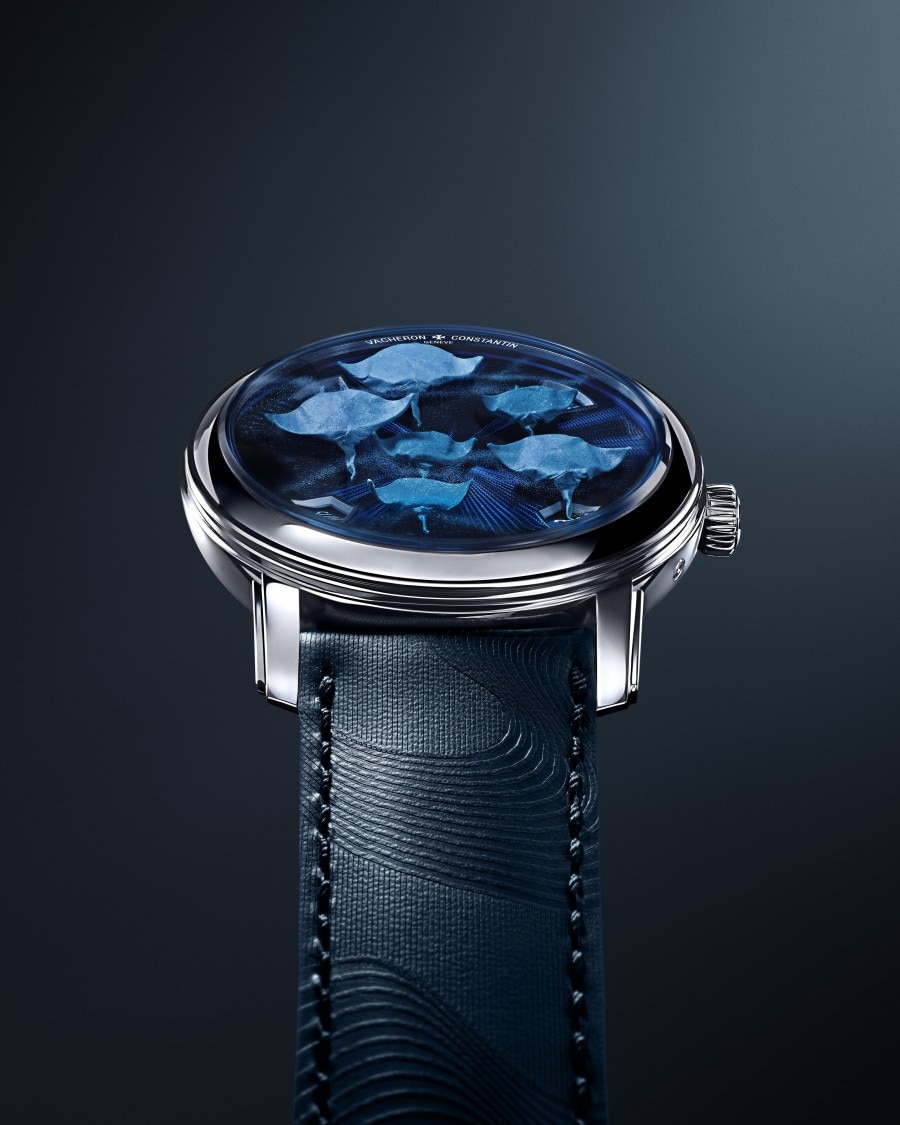
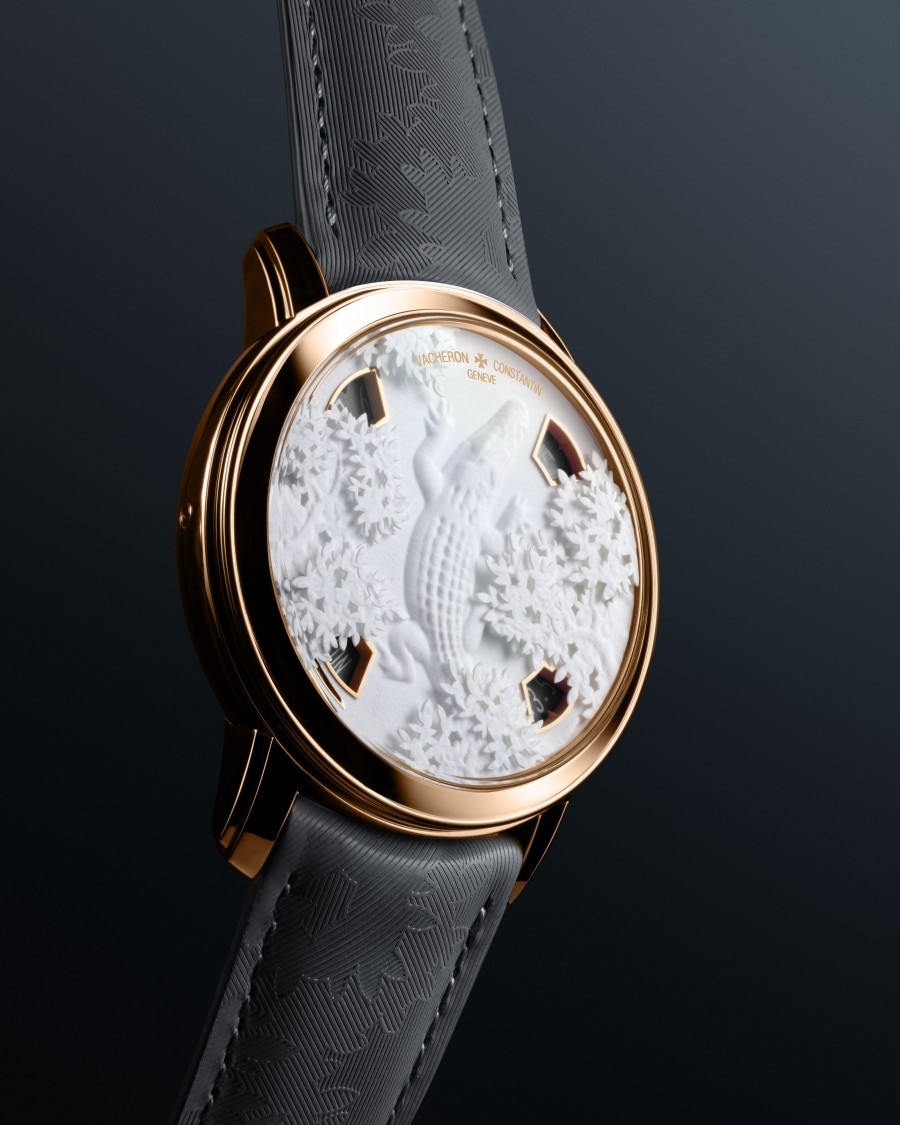
What happens when paper sculpture is compressed to watch-dial scale? Vacheron Constantin’s 2026 Tribute to the Animal Kingdom project offers two unusually extreme answers: micro-origami manta rays only a few millimetres long, and a crocodile assembled as a layered relief in cotton paper.
For the piece nicknamed Oraygami, paper artist Anya Midori folds manta rays measuring roughly 5–10 mm from squares of specially dyed Japanese paper only 9–12 mm across. The folds are made with fingers, fingernails and a toothpick. At this scale, the usual geometry of origami becomes a problem of material tolerances: a fraction of a millimetre can change both the shape and the way the tiny figure sits within the dial.
The second paper-based piece, informally called Papercroc, was developed with designer Marianne Guely. Here the material is 250–300 gsm cotton paper. The crocodile’s relief emerges through embossing, laser cutting and hand assembly, with successive elements superimposed to create depth, texture and shadow. Heated brass matrices are used to shape the paper before the final construction.
The interest for a paper modeller lies less in the luxury object than in the technical inversion. Paper is usually chosen because it is accessible and can be worked at modest scale with simple tools. Here the same material is pushed toward extreme miniaturisation and precision. The result makes its fibres, thickness and capacity to hold a relief more visible, not less.
It is also a useful reminder that layered paper construction and origami are not separate worlds. Both depend on controlling how a nominally flat sheet occupies space; the difference is whether the volume emerges primarily from folding or from superposition.
Source: Vacheron Constantin — Tribute to the Animal Kingdom
Leave a Reply